
TL;DR
Private wells in Northern New Jersey are not automatically monitored — testing is entirely the homeowner’s responsibility. Every well should be tested annually for bacteria, nitrates, arsenic, lead, copper, and gross alpha. Region-specific tests for radon and VOCs matter depending on your location. Hardness, iron, pH, and sediment explain most of the everyday symptoms you see at home. Test first, then treat. Schedule a free water test to find out what is in your well.
Northern New Jersey homeowners on private wells often ask us a straightforward question: what should I actually test for?
It is the right question to ask first. In the upper Raritan River watershed alone — which includes parts of Hunterdon, Somerset, and Morris counties — approximately 80 percent of households rely on private wells for drinking water. Unlike municipal customers, well owners receive no automatic monitoring or regulatory oversight of their water quality. Testing is not optional. It is the only way to know what your family is actually drinking.
At the same time, test packages can be confusing. It is easy to either under-test and miss something important, or pay for a broad panel that does not fit your specific situation. Below, we walk through what we recommend for a Northern New Jersey private well owner, why each parameter matters, how it connects to the symptoms you may already be seeing at home, and what treatment typically solves the problem.
The Raritan Headwaters Association recommends annual well testing across the watershed because water quality can shift over time with seasonal weather patterns, changes in well condition, and activity on neighboring properties. Roughly 1,600 households already participate in annual testing each year.
Core health and safety tests every NJ well needs
These are the non-negotiable parameters for private wells in Northern New Jersey. They target contaminants with documented health effects and known presence in our region.
1. Total coliform and E. coli bacteria
The problem Bacteria are among the most common and most consequential things to test for first. A total coliform test screens for general bacterial contamination. A positive result typically triggers a follow-up test specifically for E. coli.
The cause Coliform and E. coli typically enter a well through:
- Surface water intrusion after heavy rain or flooding
- A damaged or poorly sealed well cap
- Contamination from a nearby septic system
The impact Coliform bacteria indicate that surface or waste contamination may be reaching your well. E. coli is a more serious indicator, associated with fecal contamination and potential gastrointestinal illness. Critically, water can look and taste completely normal while carrying harmful bacterial loads.
The solution A positive bacteria result typically requires:
- Shock chlorination of the well and plumbing system
- Physical inspection of the well cap, casing, and surrounding grading
- Installation of a continuous disinfection system — most commonly UV treatment, with or without chemical feed — if the contamination is recurrent
If you have infants in the home, family members with compromised immune systems, or have experienced unexplained gastrointestinal illness, this test is urgent.
2. Nitrates
The problem Nitrate is a common well contaminant in agricultural and suburban areas across Northern New Jersey. It has no taste, odor, or color.
The cause Elevated nitrates typically come from:
- Fertilizer applications on lawns and farm fields
- Septic system seepage
- Animal waste from nearby properties
The impact Nitrate is primarily a risk for infants under six months. At elevated levels it can cause methemoglobinemia — commonly called “blue baby syndrome” — a condition where the blood loses its ability to carry oxygen effectively. For formula-fed infants, nitrate testing is not optional. For adults, chronic exposure is not desirable and often indicates broader contamination of the groundwater.
The solution If nitrate levels exceed the EPA’s maximum contaminant level of 10 mg/L:
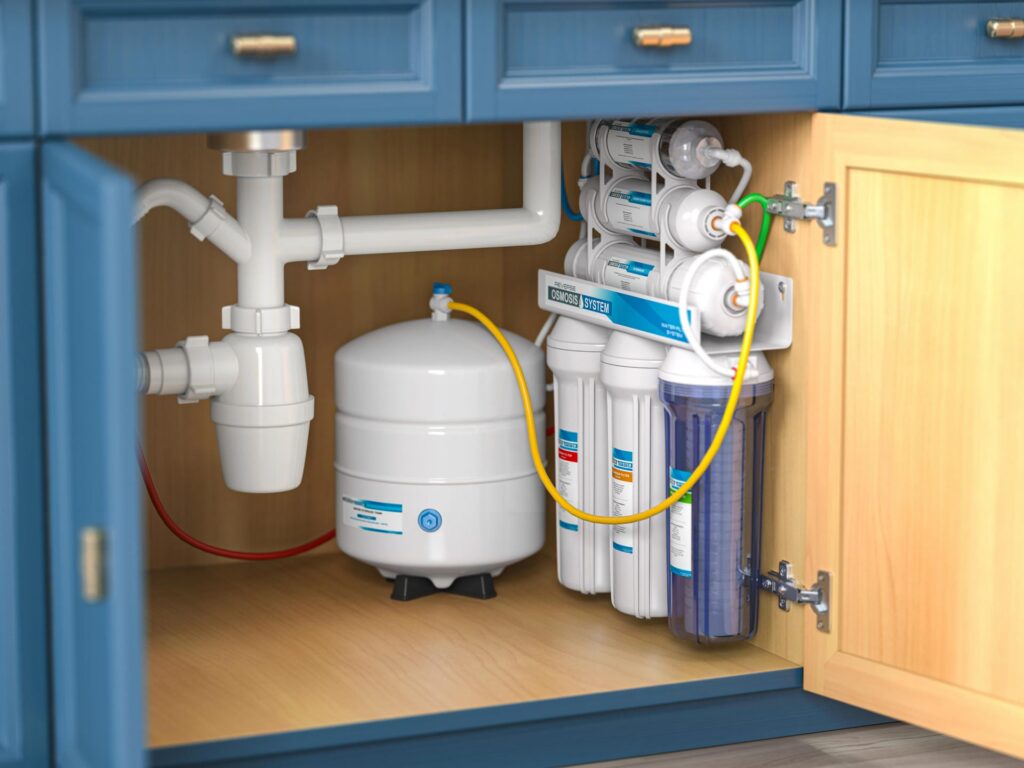
- Point-of-use reverse osmosis at the kitchen sink is the most common residential solution
- Dedicated nitrate-reduction systems are available for whole-home treatment in more serious cases
3. Arsenic
The problem Arsenic occurs naturally in certain New Jersey bedrock formations. It has no taste, smell, or color. It must be identified by laboratory analysis.
The cause Naturally occurring arsenic dissolves from specific rock types and enters groundwater as it moves through the aquifer. This is a geological condition, not the result of human activity.
The impact Long-term exposure to arsenic in drinking water is associated with increased risk of several cancers and other chronic health effects. The Raritan Headwaters mapping data confirms that multiple wells across the watershed have tested above health-based guidelines for arsenic, with significant geographic variation even within small areas.
The solution – Point-of-use reverse osmosis for drinking and cooking water – Whole-home arsenic reduction systems using specific filtration media – Combined pre-treatment and reverse osmosis where multiple contaminants are present
Because arsenic is both serious and completely undetectable without testing, we consider it a baseline test for most Northern New Jersey well owners.
4. Uranium and gross alpha (radioactivity)
The problem Naturally occurring radioactive elements — including uranium and radium — are present in some rock formations and can be carried into groundwater.
The cause These contaminants are geological in origin. You cannot see, taste, or smell them.
The impact Elevated gross alpha activity or uranium levels increase long-term cancer risk with chronic exposure. Raritan Headwaters mapping identifies pockets of wells testing high for gross alpha across the watershed.
The solution – Specialty whole-home treatment systems designed to remove uranium or radium from the supply – Point-of-use systems for drinking water where levels are more moderate
Because health effects accumulate over years, we recommend periodic retesting even after a treatment system is in place to verify that performance is holding.
5. Volatile organic compounds (VOCs)
The problem VOCs are a broad class of chemicals that includes industrial solvents, dry cleaning compounds, and petroleum-related contaminants. They are often invisible, with little or no detectable taste or odor at low concentrations.
The cause Potential sources include:
- Former industrial sites or commercial dry cleaners
- Leaking underground fuel storage tanks
- Historical improper disposal of chemicals or solvents
The impact Some VOCs are known or suspected carcinogens. Others affect the liver, kidneys, or nervous system. Even low-level continuous exposure is concerning for well owners near historically industrial or commercial corridors.
The solution – Granular activated carbon filtration, either point-of-use or whole-home, for many VOC types. Note that carbon media effectiveness varies significantly by specific compound — the appropriate system design depends on identifying which VOCs are present, not just whether VOCs are detected – Multi-stage treatment systems designed around the specific chemicals identified in your test results
If your property is near an older commercial area, a former gas station, or if you know of underground tanks on or near your land, a VOC screen belongs in your initial test panel.
6. Lead and copper from plumbing
The problem For private well owners, lead and copper contamination often originates inside the home’s plumbing rather than in the groundwater itself. This is particularly common in homes built before 1986, when lead-based solder and brass components were standard.
The cause Low pH or corrosive water dissolves metals from:
- Older lead-based solder joints
- Brass fixtures and fittings
- Copper piping in homes with aggressive water chemistry
The impact Lead is harmful at any exposure level for children and pregnant women, with documented effects on neurological development. Elevated copper can cause gastrointestinal symptoms and, over extended periods, affect the liver. Both metals can also produce visible symptoms — blue-green staining on fixtures, metallic taste in water, and in some cases discoloration of light-colored hair.
The solution – Test water pH and assess corrosion potential as a first step – Install pH and alkalinity adjustment to make the water less corrosive to metal plumbing – Add point-of-use filtration specifically certified for lead reduction where needed
For the most accurate results, collect both a “first draw” sample — water that has sat in the pipes overnight — and a “flushed” sample after running the tap for several minutes. Comparing these two results shows how much metal is leaching from your household plumbing specifically, independent of what is in the groundwater.
Region-specific contaminants Northern NJ wells should consider
Beyond the core health panel, Northern New Jersey has several region-specific concerns we recommend testing for at least once, with retesting as local conditions change.
7. Radon in water
The problem Radon is a naturally occurring radioactive gas. Most homeowners think of radon only as an air quality concern, but it can also be present in well water in measurable concentrations. During showering, dishwashing, and other water use, radon can transfer from the water into indoor air.
A note on testing: Water radon testing is separate from the basement air radon test you may have already completed. A standard air test does not measure waterborne radon. If your home already has elevated air radon levels, a water-specific radon test helps determine how much of that radon is originating from the well versus migrating through the foundation — an important distinction for treatment planning.
The cause Radon enters groundwater as it moves through uranium- and radium-bearing rock formations, which are present in parts of Northern New Jersey’s geological profile.
The impact Long-term exposure to elevated radon in indoor air is linked to increased lung cancer risk. The EPA has proposed a maximum contaminant level for radon in drinking water at 300 pCi/L with a complementary multimedia mitigation program, or 4,000 pCi/L as an alternative standard. Even if your home’s air radon levels are manageable, water radon can be a meaningful contributor that warrants separate evaluation.
The solution – Aeration systems, where water is sprayed in a sealed tank and the radon is vented safely outdoors – Granular activated carbon systems specifically designed for radon removal, typically paired with pre-filtration
8. Using local mapping data to guide your panel
The Raritan Headwaters Association analyzed ten years of private well test data from 2011 to 2020, covering a 470-square-mile watershed. Their interactive maps display contamination patterns in one-square-mile segments, giving well owners a localized starting point for understanding what neighbors have found in their water.
We use this kind of regional data when designing initial test panels for Northern New Jersey homeowners. If local mapping shows a cluster of wells with elevated arsenic or a particular VOC in your immediate area, that directly shapes which parameters belong in your first test.
Local mapping is a planning tool, not a substitute for testing your own well. Groundwater quality can vary significantly between neighboring properties depending on well depth, casing condition, and local geology.
Aesthetic and nuisance tests that explain everyday symptoms
Once the health and regional parameters are addressed, the next tier covers water quality issues that directly affect your comfort, fixtures, and equipment — even when they do not present a direct health risk.
9. Hardness (calcium and magnesium)
The problem Hard water is extremely common in Northern New Jersey wells. Visible signs include:
- White or chalky scale on faucets, showerheads, and shower doors
- Spotting on glassware and dishes
- Soap that produces little lather and is difficult to rinse clean
- Skin that feels tight or dry after bathing
The cause Hardness comes from dissolved calcium and magnesium picked up as groundwater moves through limestone and other mineral-rich rock formations.
The impact Hard water is not a direct health concern, but it:
- Shortens the life of water heaters, dishwashers, and washing machines by depositing scale on heating elements
- Increases energy use as scale insulates those elements
- Creates persistent cleaning and comfort challenges throughout the home
The solution A properly sized ion exchange water softener is the standard solution for hardness. Before investing, understand that softeners and filters solve different problems — a softener removes hardness minerals specifically, while filters address a different set of contaminants. Proper sizing based on your tested hardness level is critical for long-term performance.
10. Iron and manganese
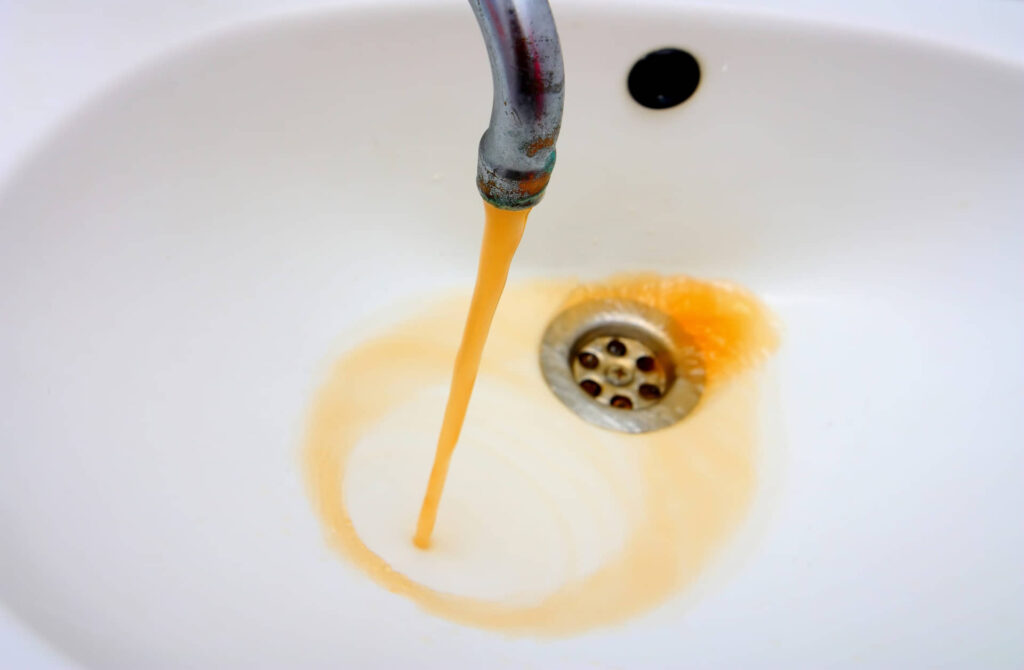
The problem Iron and manganese are among the most common nuisance contaminants in Northern New Jersey wells. They typically cause:
- Reddish-brown or orange staining on fixtures, toilets, and laundry
- Black or dark brown staining from manganese specifically
- A metallic taste in drinking water
- Discolored water after the system sits overnight
The cause Naturally occurring metals in rock and soil. Iron can be present as dissolved ions invisible at the tap, or as visible particles depending on the well and water chemistry.
The impact Iron and manganese are primarily nuisance issues at typical residential concentrations, but they:
- Permanently stain toilets, tubs, clothing, and dishware
- Clog filters, fixtures, and appliance components over time
- Can interfere with other treatment systems — particularly water softeners — if not addressed upstream
The solution Treatment depends on the form of iron present:
- Oxidizing filters that convert dissolved iron and manganese to filterable particles
- Sediment prefiltration where visible particles are already present
- In some cases, softening combined with iron-specific filtration media
Testing for both total iron and dissolved iron (ferrous) helps us choose the right system design for your specific well.
11. Sediment and turbidity
The problem Cloudy water, visible grit in glasses, or sand in toilet tanks are all signs of suspended solids.
The cause – Fine silt or sand in the aquifer – A well pumping at slightly above its optimal rate – Disturbed geology following well service or pump replacement
The impact – Abrasive wear on valves, faucet cartridges, and appliance components – Clogged aerators and showerheads – Accelerated fouling of downstream treatment equipment including softeners and reverse osmosis systems
The solution Sediment testing and visual analysis guide decisions about filter type and micron rating. A single cartridge sediment filter is sufficient in mild cases. Heavier sediment loads may require multi-stage filtration or a backwashing media system at the point of entry.
12. pH and corrosion potential
The problem Water that is too acidic or too alkaline creates problems that often go unnoticed until visible corrosion or plumbing failures appear.
The cause Naturally low pH groundwater, combined with low alkalinity, produces “aggressive” water that draws dissolved minerals from your plumbing to chemically balance itself.
The impact Typical symptoms include:
- Blue-green staining in sinks and tubs
- Pinhole leaks in copper pipes
- Bitter or metallic taste in cold water
- Greenish tint in light-colored hair from dissolved copper
Over time, corrosive water shortens pipe and fixture life and contributes to elevated copper and lead levels at the tap.
The solution – pH and alkalinity adjustment using a neutralizing filter or chemical feed system – Follow-up testing for lead and copper after treatment begins to confirm the water is no longer leaching metals
13. Chloride, sodium, and TDS (baseline chemistry)
Even without specific symptoms, we often recommend including:
- Chloride and sodium, which can increase from road salt runoff or softener discharge into the water table
- Total dissolved solids (TDS), an overall measure of dissolved minerals and salts in the water
These parameters do not tell the whole story individually, but they help us:
- Diagnose unexplained taste issues
- Size and design reverse osmosis systems accurately
- Understand how your water interacts with coffee makers, ice machines, and other small appliances over time
A practical test panel for Northern New Jersey wells
Because every well and household is different, the exact panel will vary. But for most Northern New Jersey private well owners, a solid starting point includes:
Health and safety: – Total coliform and E. coli – Nitrate – Arsenic – Lead and copper – Gross alpha or uranium
Regional priorities: – Radon in water – VOC screen, informed by local mapping data
Baseline chemistry and nuisance parameters: – pH, hardness, alkalinity, TDS – Iron and manganese – Chloride and sodium – Sediment and turbidity
From there, we refine the panel based on what you see at home. If you notice staining, scale, dry skin, unusual tastes, cloudy water, or appliance problems that seem connected to your water, those symptoms point toward specific parameters to prioritize.
Once we know what is in your water, the path to the right treatment becomes straightforward. The goal is to solve real, confirmed problems — not to over-invest in equipment for issues that are not actually present in your supply.
The next step for Northern New Jersey well owners
In the Raritan watershed and across Northern New Jersey, private wells are an excellent water source — but they come with personal responsibility. The Raritan Headwaters Association’s data makes clear that contamination patterns vary by neighborhood, and that regular testing — approximately once per year — is the only reliable way to track your water quality over time.
Residents can participate in Community Well Testing events through local drop-off points or order kits online, with results typically available in two weeks along with guidance on next steps if contamination is identified.
If you would like professional guidance on interpreting your results or designing a treatment plan based on your specific water chemistry, we are glad to help. Contact us to discuss your well testing results, or schedule a free water test and we will evaluate your Northern New Jersey well water and outline the most appropriate, targeted options for your home.